 Call Us:
  Mail Us:


Measuring Tools Explained: Tape, Vernier, Caliper, Gauge
 By Admin |
  April 6th, 2026
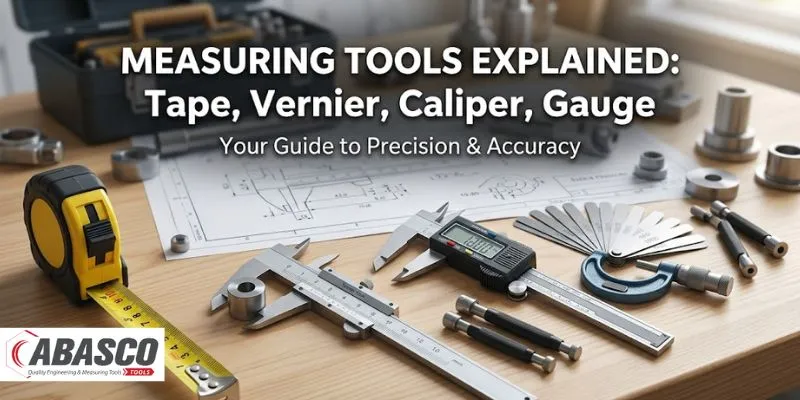
Measurement is the backbone of engineering, construction, manufacturing, and even everyday tasks. From building structures to crafting precision components, accurate measurement ensures quality, safety, and consistency. Among the most widely used tools are measuring tapes, vernier instruments, calipers, and gauges. Each serves a unique purpose, ranging from basic length measurement to high-precision analysis. If you want to buy premium-quality tools, choosing a trusted wire rope cutter supplier in Dubai, UAE ensures accuracy, durability, and long-term performance. In this blog, we will explore these vital measuring tools in detail, understanding their functions, applications, and the level of accuracy they offer.
5 Measuring Tools Every Beginner Should Know About
In this blog, we will highlight five important measurement tools that beginners should know and understand.
Measuring Tape: The Everyday Essential
A measuring tape is one of the most common and versatile tools used across industries and households. It consists of a flexible metal or fiberglass strip marked with units such as millimetres, centimetres, and inches. Its primary advantage lies in its flexibility, allowing users to measure curved surfaces, irregular objects, and long distances with ease.
Tape measures are ideal for use in the construction, tailoring, carpentry, and interior design industries. However, their precision is limited compared with advanced instruments, which typically achieve millimetre-level accuracy. Despite this limitation, measuring tapes remain indispensable for quick, approximate measurements where ultra-high precision is not required.
Vernier Scale: Precision beyond the Eye
Many of us are unaware that the vernier scale is not a standalone tool but a principle used to enhance measurement accuracy. It is an auxiliary scale that allows users to read values between the smallest divisions of a main scale. This system works by aligning markings on a sliding scale with those on a fixed scale, enabling precise interpolation of measurements.
A Vernier scale significantly reduces human error when reading small differences. The vernier principle is widely applicable to instruments such as vernier calipers, height gauges, and protractors. Its ability to measure fractions of a millimetre makes it crucial for scientific experiments, machining, and quality control.
Vernier Caliper: The Precision Workhorse
A vernier caliper is a highly versatile measuring instrument designed for accuracy and flexibility. It includes a main scale and a sliding vernier scale, along with jaws for measuring different dimensions. This tool can measure:
- External dimensions (using outer jaws)
- Internal dimensions (using inner jaws)
- Depth (using a depth rod)
Its precision typically ranges from 0.1 mm to 0.01 mm, depending on the type. Vernier calipers are ideal for mechanical engineering, manufacturing, and laboratory work because they can measure multiple dimensions with a single instrument. They are particularly useful for measuring objects that cannot be accurately measured using a ruler or tape, such as internal diameters or small components. Modern versions of vernier callipers include digital calipers, which display readings directly, making them easier to use while maintaining high accuracy. For industries that require precision calibration and testing standards, partnering with a trusted V-1 calibration block supplier in Dubai, UAE, can further enhance measurement accuracy and reliability.
Calipers: General Measurement Tools
The term “caliper” refers to a broader category of measuring tools used to determine the distance between two opposite sides of an object. While vernier calipers are the most common, there are other types, such as inside calipers, outside calipers, and dial calipers. Calipers are tools important for their simplicity and adaptability. They can measure dimensions like thickness, diameter, and width with moderate to high accuracy. Unlike measuring tapes, calipers are rigid tools, making them ideal for precise measurements of small or solid objects. Their design allows them to “grip” an object, ensuring consistent readings without guesswork.
Gauges: Tools for Comparison and Accuracy
Gauges differ from other measuring tools in that they are often used for comparison rather than direct measurement. Instead of providing a numerical reading, gauges help determine whether a dimension falls within acceptable limits. The common types of gauges include:
- Feeler gauges (for measuring small gaps)
- Screw gauges (for measuring very small thicknesses)
- Plug and ring gauges (for checking hole sizes)
Gauges are appropriate for manufacturing and quality control to ensure parts meet specified tolerances. They are essential in mass production environments where consistency is more important than individual measurement readings.
The Closing Thoughts
In conclusion, understanding industrial measuring instruments is essential for achieving accuracy, efficiency, and professional-quality results in any task. Whether you’re a beginner or a skilled professional, the right tools can make all the difference. So, if you’re looking for reliable, precise instruments you can trust, Abasco Tools offers a wide range of high-quality measuring instruments designed to meet your needs. Upgrade your toolkit with Abasco Tools, a leading workbench and workstation supplier in Dubai, UAE, today, and take your work to the next level with confidence and accuracy.
Related Posts
Recent Posts
Popular Posts

Categories
Tags
Join the League of Craftsmen
Contact UsGet In Touch
Find us on Facebook
