 Call Us:
  Mail Us:


The Difference between Cutting, Grinding & Polishing Tools: Complete Breakdown
 By Admin |
  May 11th, 2026
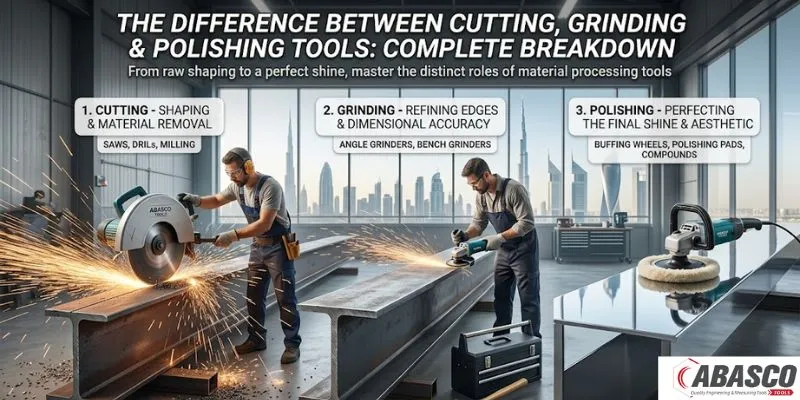
In the world of manufacturing, fabrication, and even DIY craftsmanship, understanding the difference between cutting, grinding, and polishing tools is essential. While these tools may seem similar at first glance, each serves a distinct purpose in shaping, refining, and finishing materials. Therefore, choosing the right tool not only improves efficiency but also ensures precision, safety, and superior results.
For professionals seeking reliability, partnering with a trusted toolbox supplier dealer in Dubai, UAE can ensure access to quality tools and organized solutions for every task. So, let’s break down each category in detail.
Cutting Tools: Precision in Every Cut
Cutting tools are ideal for removing components from a workpiece to develop a desired shape or size. They are typically the first step in any material processing workflow.
These tools work by applying force to shear off material, often producing chips or fragments. Cutting tools are widely used across industries such as construction, metalworking, woodworking, and automotive manufacturing.
Common Types of Cutting Tools:
- Saws (circular saws, band saws)
- Drill bits
- Milling cutters
- Turning tools (lathe tools)
Key Characteristics
- Sharp edges for precise material removal
- High cutting speed and efficiency
- Suitable for metals, wood, plastics, and composites
Applications:
Cutting tools are your go-to choice when precision material removal and shaping are the priority. They come into action when you need to:
- Separate materials into smaller pieces
- Create holes or slots
- Shape raw materials into basic forms
Grinding Tools: Refining Every Edge
Grinding tools come into play after precise cutting. They are essential for refining surfaces, removing excess material, and improving dimensional accuracy.
Unlike cutting tools, grinding tools use an abrasive wheel or surface to gradually wear away material. This process is more controlled and precise. Get in touch with a renowned brass hammer supplier in Dubai, UAE, if you are in search of high-quality grinding tools.
Common Types of Grinding Tools:
- Angle grinders
- Bench grinders
- Surface grinders
- Cylindrical grinders
Key Characteristics:
- Use abrasive particles instead of sharp blades
- Provide higher precision than cutting tools
- Generate smoother surfaces
Applications:
Grinding tools are ideal for precision surface refinement and controlled material removal, making them essential for achieving accuracy and smooth finishes. They are ideal for:
- Removing burrs and rough edges
- Sharpening tools
- Achieving tight tolerances
- Surface preparation before finishing
Polishing Tools: Perfecting the Final Shine
Polishing tools are necessary in the final stage of material processing. Their purpose is to enhance the surface finish, making it smooth, shiny, and visually appealing.
Instead of removing large amounts of material, polishing focuses on micro-level refinement using soft pads, compounds, or fine abrasives.
Common Types of Polishing Tools:
- Buffing wheels
- Polishing pads
- Rotary polishers
- Orbital polishers
Key Characteristics:
- Minimal material removal
- Enhances gloss and smoothness
- Improves aesthetic appeal
Applications
Polishing tools are necessary for the final stage of surface enhancement, where the focus shifts from shaping to achieving a flawless finish. Therefore, they play a crucial role in:
- Mirror-like finishes on metal and glass
- Automotive detailing
- Jewelry and decorative items
- Final finishing in manufacturing
Key Differences at a Glance
From raw shaping to final shine, cutting, grinding, and polishing tools each play a distinct role in material transformation. Here’s the list of key differences between cutting, grinding, and polishing tools.
- Purpose: Cutting shapes and removing bulk material, grinding refines and smooths with precision, while polishing delivers the final shine and visual perfection.
- Material Removal Rate: Cutting is fast and aggressive, grinding is controlled and moderate, and polishing is minimal, focused on finesse, not removal.
- Tool Mechanism: Cutting tools slice with sharp edges, grinding tools wear surfaces down using abrasives, and polishing tools glide with soft pads and compounds for a flawless touch.
- Surface Finish: Cutting leaves a rough base, grinding smooths it out, and polishing elevates it to a glossy, mirror-like finish.
The Conclusion
In every project, the right sequence of cutting, grinding, and polishing defines the difference between average results and exceptional craftsmanship. Therefore, mastering these tools ensures precision, durability, and a flawless finish every time. If you’re looking to elevate your work with reliable, high-performance solutions, Abasco Tools can be your trusted partner. From robust cutting equipment to precision grinding and premium polishing tools, Abasco Tools, the best portable hardness tester supplier in Dubai, UAE, can deliver quality you can depend on. So, why wait? Upgrade your toolkit today and experience the power of perfection with Abasco Tools.
Related Posts
Recent Posts
Popular Posts

Categories
Tags
Join the League of Craftsmen
Contact UsGet In Touch
Find us on Facebook
